
In this post:
How do you talk about plans in English?
In most cases, you will need the spoken pattern BE GOING TO to talk about your plans, intentions, or something you think is likely to happen (based on evidence).
Grammatically, it is not difficult – you just add a verb after it:
For present: AM / IS / ARE + GOING TO + verb – e.g. I’m going to call you later.
For past: WAS / WERE + GOING TO + verb – e.g. I was going to call him yesterday. (you planned to do it in the past)
But while it is quite easy to build a sentence with it, understanding this structure when other people say it may not be that simple.
BE GOING TO is one of the most common spoken English structures. It’s used all the time. And that’s why they may pronounce it in a very relaxed way, and it is not easy to hear it sometimes, frankly.
This post provides some English listening practice for you – this way, you will not only remember the pattern and SEE the examples with it, but you will also practise understanding such sentences by ear.
There are 30 GOING TO sentences in this post. They will show you three main situations when BE GOING TO is used in everyday speaking.
Go through them step by step and practise when you have a minute. This will help you make your English listening stronger.
What you need to know about GOING TO pronunciation
There are three ways this spoken pattern can be pronounced:
- Full form – be going to (usually said when a person speaks slowly, is in doubt or being thoughtful, or pronounced carefully by non-natives)
- Conversational form – be gonna (in most cases in non-formal communication)
- Reduced form – Imuna (when speaking emotionally or between people who know each other very well)
Listen to this difference here:
Kind of hard to hear it sometimes, right?
So, here’s where listening practice comes in handy. So, let’s do it.
1. Be going to – for plans
When do you need to use BE GOING TO?
First, when you talk about your plan or something you have decided to do. It can be just your intention or something you have thought through.
This is the most popular use of BE GOING TO, so we will listen to the examples with it first.
How to practise
First, listen to the audio and try to understand the 10 sentences. You will hear each sentence twice:
- said slowly
- spoken at a natural speed
After that, click the grey block and read the text. Listen to the sentences again with the text.
And lastly, listen to the sentences one more time to make sure you can understand them by ear now.
Click here to see the sentences
- Are you going to finish those chips?
- What are you going to wear to Tom’s wedding?
- We’re not going to do anything big for my birthday this year, just dinner with a few friends.
- She’s going to drive up to see her parents on Saturday.
- Right, I’m gonna have a quick shower, and then we can head out.
- I’m gonna grab some coffee. Do you want anything?
- I’m not going to bother cooking tonight. I’m just gonna get a takeaway.
- So is he gonna take the job in Berlin, or is he going to stay where he is?
- I’ve decided I’m going to stop answering work calls after six. It’s just not worth the stress.
- Next time we go to Lisbon, we’re going to skip the tourist spots and just wander round the old neighbourhoods.
And then do the same with Parts 2 and 3.
2. Be going to – for predictions
Secondly, you will use BE GOING TO when you can see or know that something is likely to happen.
Like, when you are looking at a big grey cloud in the sky and think to yourself, ‘It’s going to rain soon.’ The cloud is the evidence that it will rain for sure.
Practise listenig to the sentences where BE GOING TO is used like that.
Click here to see the sentences
- Look at the blue sky. It’s going to be a lovely day.
- He’s driving much too fast. He’s going to get a speeding ticket.
- The bus is really late. We’re going to miss the start of the film.
- I’ve eaten far too much. I think I’m gonna be sick.
- Be careful! You’re gonna step in that puddle.
- Look at that queue! We aren’t gonna get into the museum before lunch.
- The baby keeps rubbing her eyes, so she’s going to fall asleep any minute.
- The temperature is dropping fast. Is it gonna snow tonight?
- Our flight has been delayed twice, so we’re definitely not going to make our connection in Frankfurt.
- Judging by the size of the crowd at the gate, boarding is gonna take ages.
Like it? Save it for later
3. Was going to – for past intentions
You will also hear BE GOING TO in the past a lot. So, it can help you describe something you planned to do in the past (and got interrupted).
In many cases, this plan didn’t get realised for some reason, but you want to make sure a person knows you had planned to do it.
Listen to these sentences to see how it works.
Click here to see the sentences
- I was going to call him, but forgot.
- We were gonna go to the beach, but it rained all day.
- She was going to buy a new phone, but it was too expensive.
- Sorry, what was I going to say? I’ve completely forgotten.
- They weren’t going to come to the party, but in the end they changed their minds.
- I was just going to call you when your message arrived.
- He was going to take a taxi to the airport, but a friend offered him a lift.
- We were going to stay in Rome for three days, but we loved it so much that we stayed a whole week.
- I was going to book the hotel last night, but by the time I got round to it, all the cheap rooms had gone.
- I was going to complain to the manager, but the waiter apologised so sincerely that I didn’t have the heart.
And that’s it.
I hope you have found this practice useful. It’s very important not to forget about listening when learning English. It is an essential, but, unfortunately, one of the most neglected skills.
You can use sites like youglish or playphrase.me for improving your English listening any time – just type in the structure you’re trying to remember and listen to the examples of how people use it in real life. This will help you remember that structure much better.
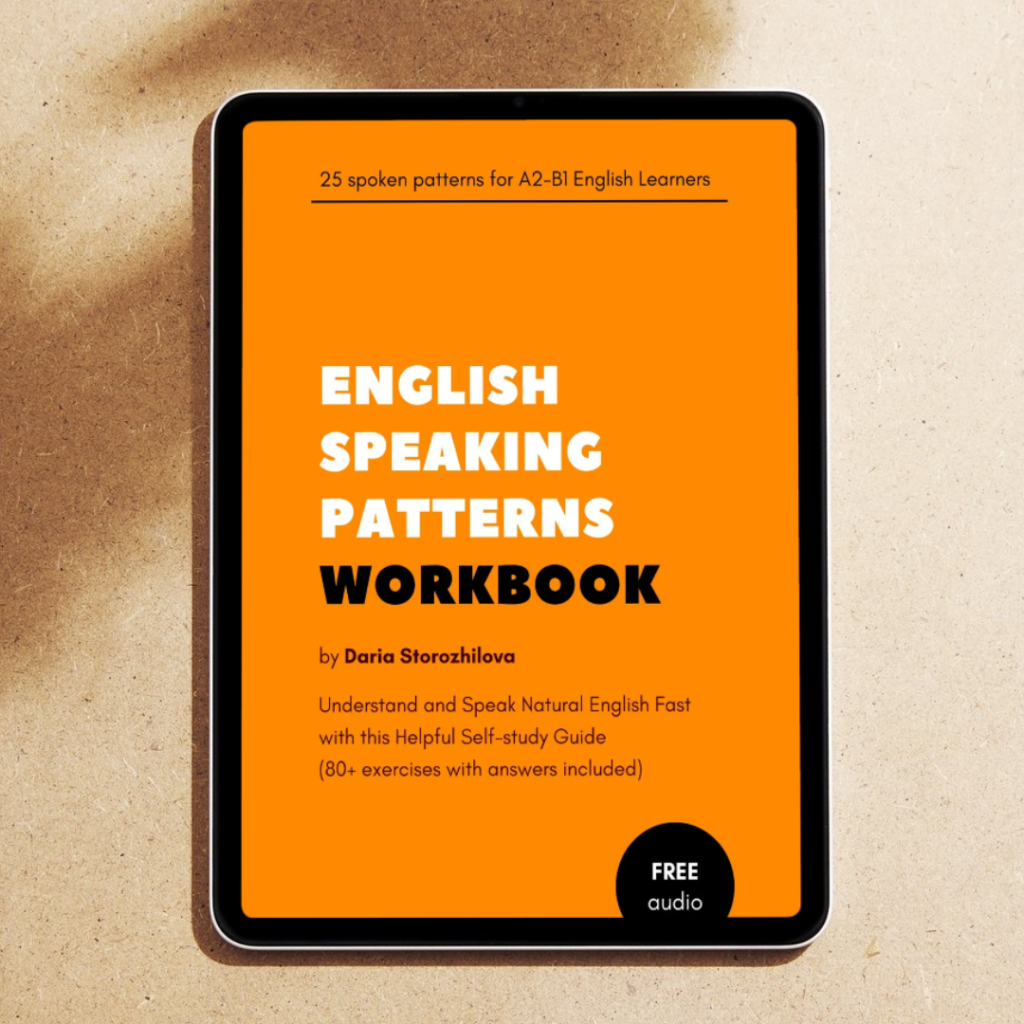
English Speaking Patterns Workbook
And if you want to keep learning English in this fun and practical way, check out my book. It will help you master 25 spoken patterns like that, improve your English listening and fluency. It’s worth a look!